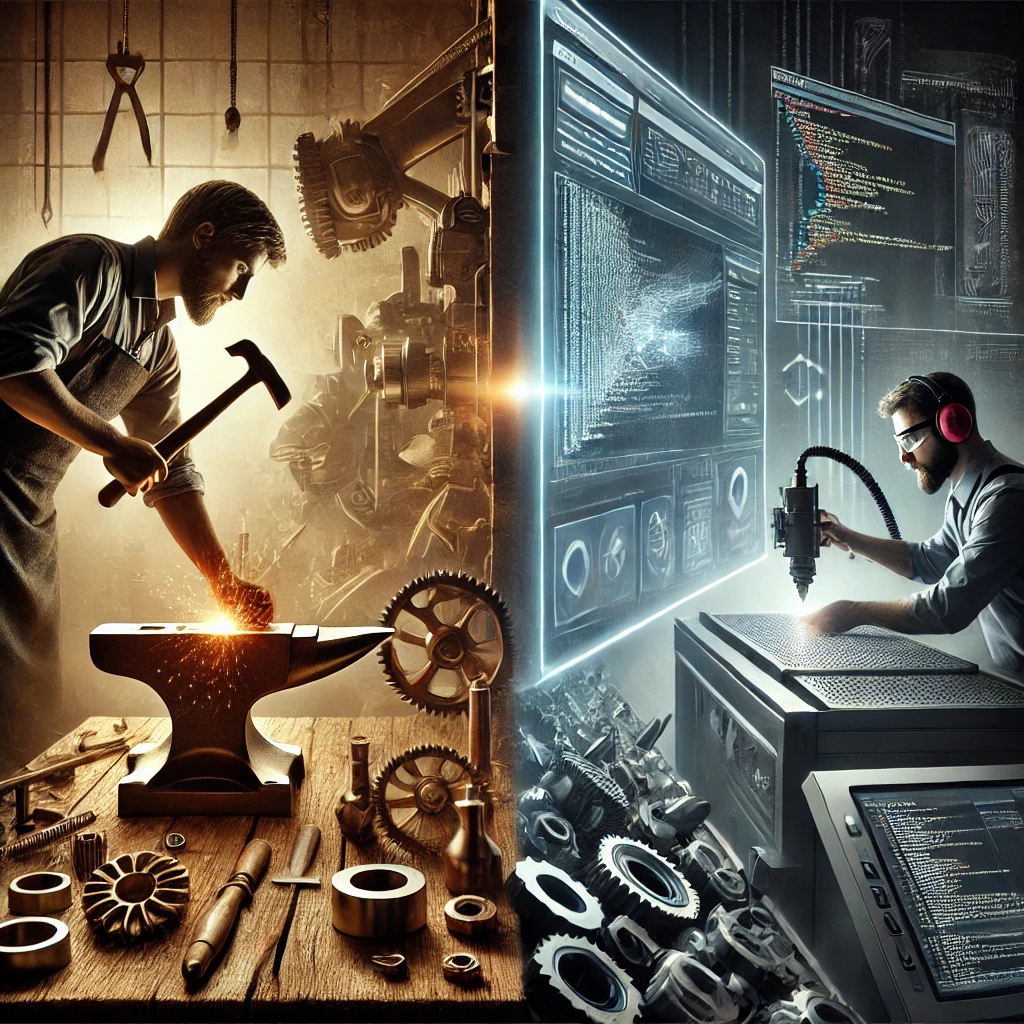
From Artisan Craft to AI-Enhanced Precision
In the early days of software engineering, the field resembled a high-stakes artisan craft. Programmers painstakingly designed, wrote, and debugged code, often wielding intimate knowledge of both hardware constraints and software nuances. It was a world where expertise and intuition reigned supreme, akin to the master woodworker sculpting intricate furniture by hand. However, as technology evolves, software engineering is poised to undergo a transformation parallel to the advent of Computer Numerical Control (CNC) machines in manufacturing: a shift from mastery of the craft to mastery of the tools that automate the craft.
Let’s explore this metaphor further to understand how software engineering is evolving and what it means for the future of our profession.
The Art of the Craft Master: Software Development Today
In many ways, contemporary software engineering still carries the hallmarks of an artisan’s workshop. Despite an abundance of frameworks, libraries, and automation tools, the process remains intensely manual and requires a deep understanding of programming languages, systems architecture, and domain-specific challenges. Software engineers today are akin to pre-CNC craft masters who meticulously shaped raw materials with precision tools and years of honed skill.
- Creativity and Problem-Solving: Just as the master carpenter conceptualizes a bespoke design, software engineers craft tailored solutions to unique business challenges. In an era of powerful automation, this creativity increasingly involves selecting the right abstractions, designing resilient architectures, and ensuring that ideas align with strategic goals while remaining adaptable to future changes.
- Iterative Perfection: Bugs are fixed and features are refined in a process analogous to sanding and polishing.
- Domain Expertise: Engineers, like artisans, rely on an intricate understanding of their medium—whether it be machine code, web technologies, or machine learning algorithms.
But the winds of change are howling. Just as the CNC machine revolutionized manufacturing, advanced code-generation tools are poised to redefine the software engineering landscape.
Enter the CNC Era of Software Engineering
What is CNC?
Computer Numerical Control (CNC) refers to the automated control of machining tools (such as drills, lathes, and mills) through pre-programmed software. CNC technology enables precision and repeatability in shaping materials like wood, metal, plastic, and composites. From intricate wood carvings to aerospace-grade metal components, CNC machines have revolutionized industries by automating tasks that were once labor-intensive and required exceptional manual skill.
CNC machines revolutionized manufacturing by automating labor-intensive processes, enabling precision and repeatability. Similarly, AI tools in software engineering streamline code generation, refactoring, and debugging, empowering engineers to achieve more with less effort.
Automation in Action
AI-driven code generation tools have made it possible to:
- Generate boilerplate code in seconds.
- Suggest optimal algorithms based on a problem description.
- Automatically refactor legacy code.
- Perform in-depth code reviews at speeds no human team could match.
These capabilities allow engineers to focus less on rote tasks and more on conceptualizing and refining the architecture. However, just as CNC operators must understand machining principles to configure and troubleshoot, software engineers must maintain a robust understanding of programming to guide these tools effectively.
Evolving Skillsets
This shift demands a reimagining of the engineer’s toolkit:
- Tool Proficiency: Future engineers must excel at wielding AI-powered tools, understanding their capabilities and limitations, and taking on the critical role of ensuring these systems remain functional, efficient, and adaptable over time. With automation handling much of the code generation, the emphasis will shift to diagnosing issues, maintaining complex interconnected systems, and resolving conflicts within automated outputs.
- Problem Formulation: As tools take over implementation, defining clear, precise, and executable requirements becomes paramount.
- Debugging and Oversight: Like CNC operators tuning machine tolerances, engineers will focus on debugging and refining outputs from automated systems, while also ensuring that AI-generated solutions meet strategic business and ethical goals.
- Domain Knowledge: Context remains critical. An AI might generate code, but it’s up to the human engineer to ensure it aligns with business logic, regulatory constraints, and broader societal objectives.
The Role of Human Expertise in the CNC Era
The CNC analogy often evokes fears of obsolescence, but history shows that automation enhances, rather than replaces, human roles. The CNC revolution didn’t eliminate jobs in manufacturing—it created higher-skilled roles focused on programming and maintaining these machines.
In software engineering, the future is no different:
- Higher Abstraction Levels: Engineers will spend less time writing individual lines of code and more time steering entire systems at a high level. Mastery of architecture and abstraction will be essential for creating robust, scalable solutions. With automation shouldering the mechanics of coding, the true craftsmanship lies in designing systems where components interact seamlessly and ideas translate efficiently into value. Systems thinking will become a cornerstone skill, enabling engineers to envision, adapt, and oversee dynamic, interconnected ecosystems.
- Collaboration with AI: Humans and AI tools will co-create software, with engineers steering AI outputs and providing the nuanced judgment machines lack.
- Creative Opportunities: Freed from repetitive tasks, engineers will have more bandwidth to innovate, experiment, and push the boundaries of technology.
- Ethical Oversight: Beyond technical oversight, engineers must remain vigilant about the ethical implications of automated outputs. The precision of CNC machines parallels the accuracy of AI-generated code, but without human insight, unintended consequences may arise—whether it’s biased algorithms or inefficiencies in meeting real-world needs.
The Path Forward: Embrace Change, Enhance Skills
The transition to the CNC era of software engineering is inevitable, and resisting it is akin to lamenting the disappearance of hand-forged nails in favor of machine-produced ones. Instead, software engineers should embrace this shift and prepare themselves by:
- Investing in Continuous Learning: Familiarize yourself with AI tools and learn how to use them effectively.
- Building Strong Foundations: A deep understanding of programming fundamentals will always be essential, but equally important is the ability to conceptualize at a macro level—seeing the forest, not just the trees. Engineers must evolve into system architects who can manage complexity through abstraction, identify emergent issues before they materialize, and align technical solutions with strategic goals.
- Focusing on Oversight and Soft Skills: Communication, teamwork, and creative problem-solving will become even more valuable as engineers shift from individual contributors to orchestrators of automated processes. Additionally, engineers must sharpen their ability to diagnose systemic issues, implement resilient designs, and ensure long-term maintainability of both code and the tools themselves.
Conclusion: A Brave New World
The future of software engineering promises exciting opportunities for those who adapt. By leveraging AI-powered tools, engineers can amplify their impact and focus on the aspects of the craft that truly matter: innovation, design, and problem-solving. As we transition from the role of artisan to that of CNC operator, our ability to learn, adapt, and embrace change will define our success.
The craft is evolving, but its heart remains the same: the pursuit of building something extraordinary.
Leave a Reply